

Tree root damage is the slowest problem on your property and the last one anybody catches. Nothing falls. Nothing breaks in a storm. Nothing gets your attention on a Tuesday. What happens instead is a seam in the driveway that was hairline last spring and stands a quarter inch proud this summer, a corner of the patio you catch with a mower wheel, a ridge in the lawn where there used to be grass, a bathroom that backs up every October. By the time those register as one problem instead of four small ones, the roots have been at it for years.
So here is what is actually going on under a Cullman County lot, how to tell which of those symptoms is really the tree and which is just tired concrete, and what your honest options are once you know. Some of this ends in a technical tree removal. A good deal of it does not, and we would rather tell you that standing in your driveway than sell you a takedown you did not need.
What tree roots actually do down there
Start with the part that surprises people. A mature hardwood does not send a taproot straight down like the drawing in a grade-school textbook. Most of what the tree depends on — the structural roots that hold it up and the fine roots that feed it — sits in the top twelve to eighteen inches of soil, in a plate that spreads well past the edge of the canopy. On a big water oak, the roots are often reaching two to three times farther from the trunk than the branches do.
Roots also do not hunt. They do not seek out your foundation, and they cannot sense a sewer line and grow toward it. They grow where there is water, air, and room, and they thicken wherever they happen to be. That distinction matters more than it sounds like it should, because it changes what you are dealing with: not a tree working against your house, but a tree that has quietly filled the space you left it.
From there, tree root damage happens by two mechanisms, and they look nothing alike.
- Mechanical lift.A root that was the thickness of a garden hose when the driveway was poured is now the thickness of your forearm. It has nowhere to go but up, so it lifts whatever is sitting on it — a slab, an apron, a walkway, a paver run, a porch step. Slow, steady, and not reversible without cutting something.
- Soil moisture change.A mature tree in full leaf pulls a serious volume of water out of the ground every day it is warm. In the clay-heavy subsoil under a lot of properties around here, soil that dries out shrinks and soil that rewets swells. Footings, slabs, and crawl space piers do not appreciate either one, and that movement cracks things without a root ever touching them.
Almost every root complaint we walk up to is one of those two, or both at once. Telling them apart is most of the job, because they have completely different answers.

Where root damage shows up around a Cullman house
The driveway, the walkway, and the patio
This is the most common one by a wide margin, and it is nearly always pure mechanical lift. A root running under the edge of a concrete apron or a paver path thickens, the surface above it cracks along the line of that root, and one side sits higher than the other from then on. You can usually confirm it in about a minute: stand on the high side and sight back toward the trunks nearby. Root heave runs in a line, and the line points at the tree.
What does not point at a tree — and gets blamed on one constantly — is concrete that failed for its own reasons. A slab poured on a poorly compacted base, a driveway with no control joints, a walkway that has been through thirty winters of freeze and thaw. Those cracks are spidery and scattered rather than linear, and they do not track back to a trunk. It is worth ruling them out before anybody starts cutting roots on your behalf.
The foundation, the slab, and the crawl space
The foundation question is the one that scares people, and it deserves a straight answer. A root does not have the strength to shove over a properly built footing. What a root can do is find an opening that is already there — a crack, a gap at a cold joint, a failed patch — and thicken inside it, widening what was already going wrong. And a large tree sitting close to a slab can absolutely move the soil under that slab by drawing water out of it season after season.
So the honest position is this. If you have real structural movement, the person who diagnoses it is a foundation contractor or a structural engineer, not a tree crew. We can tell you what the tree is doing and what taking it out would change. We cannot tell you what your footing is doing, and anybody who steps out of a chipper truck and tells you otherwise is guessing on your dime.
One thing worth knowing before you decide anything: removing a big tree near a slab is not automatically neutral either. In clay that a mature tree has been drying out for twenty years, taking the tree away lets the soil rehydrate and swell, and that can move a slab too. That is not a reason to keep a dangerous tree. It is a reason to have the foundation conversation and the tree conversation in the same week rather than a year apart.
The sewer line, the septic field, and the water service
Roots in a sewer line are real and badly misunderstood. Roots do not bore through sound pipe. They enter at a defect that already exists — an open joint in old clay tile, a rusted seam in cast iron, a sloppy connection at a cleanout — because that is exactly where warm water and air are leaking out into the soil. Once a hair-fine root is through the gap it fattens inside the pipe and catches everything that comes down it.
The tell is a drain that slows on a schedule rather than all at once, and gets noticeably worse through the growing season. A plumber with a camera settles it in twenty minutes, and that is the right first call — the camera tells you whether you are looking at root intrusion or a bellied line, and those are not the same repair. Only one of them has anything to do with your tree.
Septic gets treated as its own conversation on our estimates. We will not run a stump grinder over a drain field, and if that is the only way to reach a stump we will surface-cut it and tell you exactly why we stopped there.
The lawn
Surface roots snaking across the grass are the least dangerous symptom and the most aggravating one. They scalp under the mower, they ruin a blade, and they turn a strip of yard into something nobody can keep. Sweetgums, water oaks, willow oaks, and sycamores are the usual names on that list around Cullman County — shallow-rooted by nature, and worse in compacted or thin soil where a root has no reason to go deeper.
Two common fixes make it worse. Shaving the roots off flush with a saw opens the tree to decay right at the flare, which is the last place on a tree you want decay. Burying them under four inches of topsoil smothers the fine roots that need air near the surface, and the tree answers by pushing more roots up. A mulch bed out toward the drip line, mowed around instead of through, is the boring answer that actually works.

Figuring out which tree is actually doing it
The nearest tree is not automatically the guilty one, and the guilty one is not always in your yard. Before anybody quotes you anything, a few minutes of looking usually settles it.
- Follow the line, not the leaves.Damage from a root runs along that root. Sight from the crack back toward the trunks around you and see which one it lines up with. A tree forty feet away with a plate running under the driveway beats a small one standing right next to it.
- Read the flare.Look at where the trunk widens into the ground. The big structural roots leave that flare in specific directions, and on most trees you can see which side is loaded without digging anything up.
- Measure in trunk diameters, not feet.Measure the trunk across at about chest height, then measure trunk to damage. A crack six feet from a thirty-inch oak is deep inside the root plate. The same crack six feet from a ten-inch dogwood almost certainly is not.
- Rule out the dull explanations.Old concrete, a bad base, a downspout that has been dumping at the corner for a decade, a cast-iron drain line that was due. A fair share of the root calls we take turn out to be one of those, and we say so rather than quote a removal.
Can you just cut the roots?
This is the question every homeowner asks, and the answer is: sometimes, within limits, and it is always a trade rather than a fix. Every root you sever is anchorage and water supply the tree does not get back. Cut enough of them on one side and you have not solved a driveway problem — you have built a leaning problem for four years from now.
The rule of thumb we work to is to stay outside a radius of roughly three times the trunk’s diameter before anyone cuts anything, and to never take several major roots off the same side of a tree. Inside that zone you are into structural roots, and severing those is exactly what shows up later as soil cracking on the windward side and a root plate starting to lift — the same warning signs we read on a hazard tree.
One thing to be clear about up front, because it comes up on nearly every one of these estimates: pruning the canopy does not fix a root. Taking weight out of the top is real work with real benefits, and it is not the answer to a lifted slab. If somebody quotes you a crown reduction to solve a driveway problem, that is not what pruning does.
- Root barriers and excavation are somebody else’s trade.We do not install barriers, trench for them, or repair hardscape. That is excavation and concrete work, and the way to do it well is to coordinate with whoever will be cutting near the tree so the tree survives the process.
- Grinding a root is not the same as grinding a stump.A grinder can take exposed surface roots down where they are clear of utilities. It cannot chase a root underneath a slab, and it has no business running over a septic field or an unlocated utility line.
- Removal is the only thing that stops the growth.It is the honest end of the list. A living tree adds wood to that root every single year no matter what anybody does above ground.
“Roots aren’t malicious and they aren’t in a hurry. They just fill whatever space you left them. Every decision about them is a trade — you’re picking what you’d rather live with.”
— Trenton Clemmons, Clemmons Tree Service
Live with it, work around it, or take the tree
Once you know which tree it is and which mechanism is at work, there are really only four ways this goes. Here is what each one costs you, leaving money out of it for a moment.
- Leave it alone.Right more often than people expect. A surface root in a back corner of the lawn, a hairline in a section of walkway nobody uses — that is cosmetic. A mature canopy is worth real money in shade, stormwater, and what the lot looks like. Not every root is a project.
- Work around it.Mulch bed instead of grass over the root zone. Re-route a walkway a few feet. Replace a rigid slab section with pavers or another flexible surface that can be lifted and reset as the root grows. This is the option that keeps a good tree and ends the annual argument, and almost nobody offers it.
- Cut selectively, outside the structural zone.Reasonable when the damage is far enough out from the trunk, the tree is otherwise sound, and only a root or two is involved. Do it with somebody who will tell you honestly whether the tree can take it — and do it before the concrete goes down, not after.
- Take the tree out.The right call when the tree was coming out anyway for other reasons, when the damage is close enough to the trunk that saving both is not realistic, or when what sits over the root plate is your house rather than your walkway.
When the tree has to come out
The clearest cases are the ones where roots are only part of the story. A tree already showing decay at the flare, a hardwood with a dying top, a leaner that has moved since last year — if roots are also lifting the driveway, the decision was made somewhere else and the driveway is just what finally made it obvious.
The other clear case is geometry. A large, wide-spreading hardwood eight feet off a slab has a root plate that is under the footprint of the house whether you can see it or not, and there is no pruning your way out of that. The realistic choice is to take it down on a calm week of your choosing, or to keep re-making the same decision every spring until weather makes it for you.
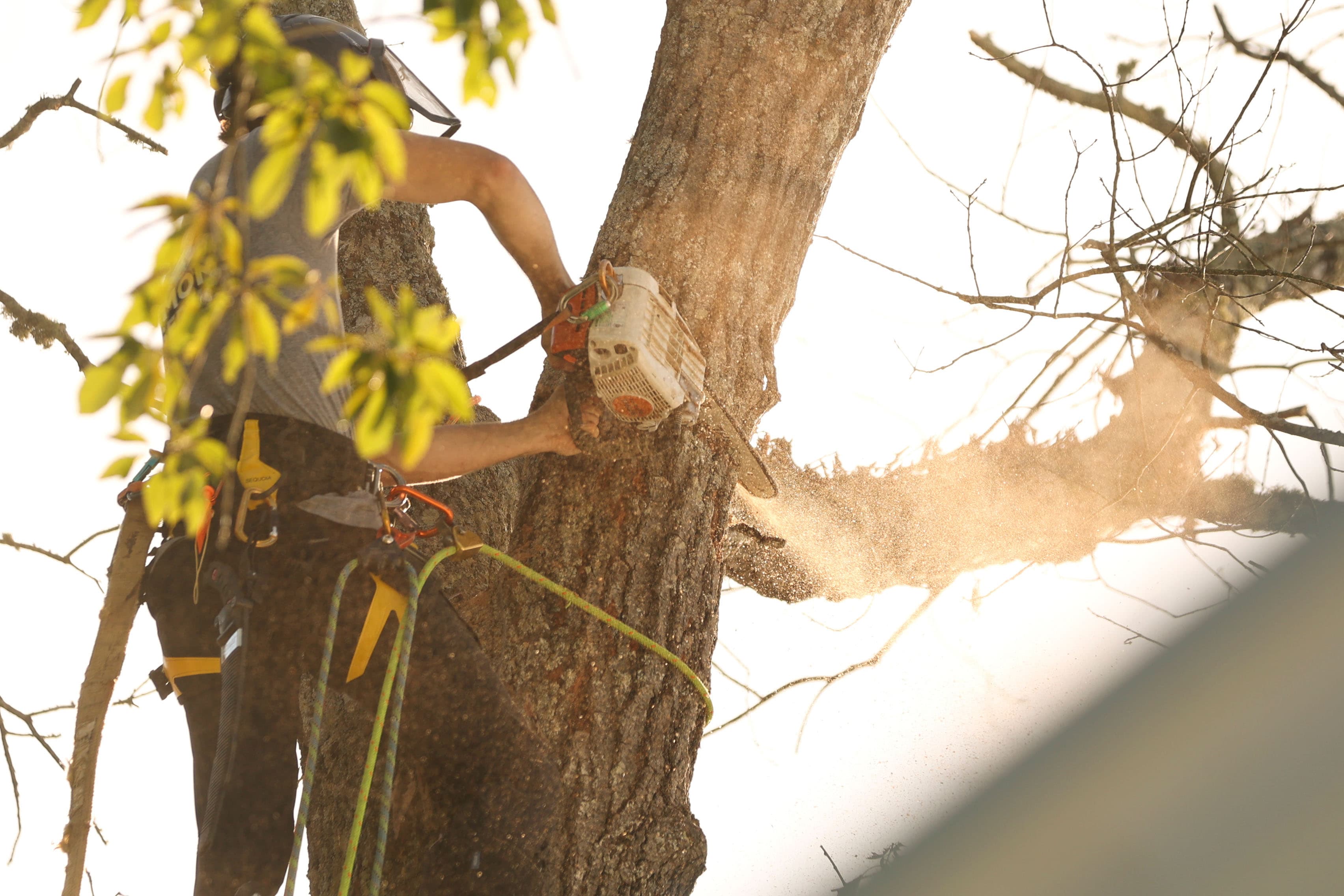
Removing a tree that tight to hardscape is technical work by definition, and it is worth understanding why the price reflects that. There is no drop zone. The whole tree comes down in pieces on ropes, because the driveway and the slab you are trying to protect are directly underneath it. Add the access, the cleanup, and the stump, and you have the five things that actually set what a removal costs.
The stump is the other half of a root job
On a root job, stump grinding is not an afterthought. It is the part that decides whether you can actually put the driveway, the patio, or the lawn back over the spot.
A grinder takes out the stump and the visible flare, and it rolls along the radial roots taking them out a few feet in each direction. What it does not do is chase the whole system — anything deep stays where it is and decomposes on its own over the next few years. For most yards that is exactly right. Under a slab, it changes what has to happen next, so tell us the plan when we quote and we will grind to it.
- Standard, 4–6 inches below grade.What most lawns need. Deep enough to grass over, walk past, and mow without ever knowing a stump was there.
- Replant or pour, 8–12 inches below grade.Where a new tree, a sod section, or concrete is going. For a pour we take every visible root out of the slab footprint and backfill the cavity with compactable fill before your concrete contractor shows up.
- Surface flush, at grade.Just the visible stump taken down to ground level. Cheapest, and honest about what it leaves behind — fine in an out-of-the-way corner, wrong under anything you plan to build on.
Two things we handle rather than leave to you. We call 811 and get the area marked before a grinder turns on, and anything you tell us about — irrigation, low-voltage wiring, an invisible fence — gets flagged and worked around instead of ground through. And we do not grind over a septic field, full stop.
The one mistake worth avoiding at the end of all this: pouring concrete straight over a fresh grind without backfilling it properly. The wood and chips left in that cavity keep breaking down, and the void they leave becomes a settled corner of a slab you just paid for. What the grinder actually leaves behind, and how to bring a yard back over it, is covered start to finish elsewhere on this blog.
What to do this week
If you think roots are behind what you are looking at, the order of operations matters more than the speed.
- Photograph it, with a date.One wide shot with the tree and the damage in the same frame, then close-ups of the crack or the ridge. Phone photos date themselves. Take the same shots next season.
- Get the unglamorous diagnosis first.A plumber’s camera for a slow drain. A foundation contractor or an engineer for real structural movement. Those answers change what the conversation about the tree is even about.
- Do not let anybody cut a root to make a problem go away.Not before somebody has looked at what that root is holding up. This is the step that turns a driveway repair into a removal three years later.
- Ask about the tree and the hardscape in the same visit.Whoever is doing the concrete and whoever is doing the tree should be working off the same plan. Sequencing is most of it — roots come out before the pour, not after.
- Have somebody walk it.Ten minutes on the ground reads the flare, the damage line, and the species, and tells you which of the four options above is actually yours.
None of that asks you to know anything about arboriculture. It asks that somebody look at the tree before anybody cuts anything, which is exactly what a free estimate is for — and the rest of what we get asked standing in the yard is written out on our FAQ page.
Tree root questions we get around Cullman
Can tree roots really damage a house foundation?
Cracking a sound, properly built footing outright is rare — a root does not have that kind of strength. Two things do happen. A root finds an opening that already exists and widens it as it thickens, and a large tree draws enough water out of clay-heavy soil that the ground under a slab shrinks and swells with the seasons. Shallow concrete — driveways, walkways, patios, porch slabs — is far more vulnerable than a footing. If you have genuine structural movement, have a foundation contractor or engineer diagnose it. We can tell you what the tree is doing and what removing it would change, but we will not pretend to read your footing for you.Can I cut tree roots that are lifting my driveway?
Sometimes, and it is always a trade rather than a fix. Every root you sever is anchorage the tree does not get back. The rule of thumb we work to is to stay outside a radius of roughly three times the trunk’s diameter, and to never take several major roots off the same side of the tree. Inside that zone you are cutting structural roots, and that is how a driveway repair becomes a leaning tree a few years later. Have the tree looked at before the concrete crew starts, not after.How close can a tree be to a house or a driveway?
There is no single number, because it depends on the species and its mature size rather than on what is standing there today. A shallow-rooted, wide-spreading hardwood like a water oak or a sweetgum needs far more room than a small ornamental. The practical way to think about it is that the root plate usually reaches two to three times as far out as the branches do — so if the canopy will eventually cover the driveway, the roots are already under it. For a tree that is already in the ground, the useful question is not the distance but what the roots are actually doing, and that is readable on site.Do tree roots get into sewer lines?
They do, but they enter at a defect that is already there — an open joint in old clay tile, a rusted seam in cast iron, a bad connection at a cleanout — rather than by boring through sound pipe. The tell is a drain that slows gradually and gets worse through the growing season. Start with a plumber’s camera, because it tells you whether you have root intrusion or a bellied line, and those are different repairs. If the tree has to come out as part of the fix, that is where we come in.Will grinding the stump kill the roots under my driveway?
Grinding takes out the stump and the visible flare and clears the radial roots a few feet out in each direction. It does not chase a root underneath a slab, and it will not remove the deeper root system — that stays in the ground and decomposes over the next few years. What it does do is stop the growth: once the tree is gone the root stops adding wood, so the lifting stops with it. If you are pouring over the spot, say so when we quote and we will grind to pour depth and get the roots out of the slab footprint.
Tree root damage in Cullman, in short
Roots are shallow and wide, they are not hunting your pipes, and they cause trouble two ways — by thickening under something rigid, and by moving the moisture in the soil beneath it. The line of the damage points at the tree that caused it. Pruning will not fix a root, cutting roots close to the trunk trades a driveway problem for a stability problem, and removal is the only thing that stops the growth. Most of this is a decision rather than an emergency, which means you get to make it on a calm week instead of after a bad one.
For a free, no-obligation look at a tree that is lifting a driveway, cracking a slab, or crowding the house anywhere in Cullman and the surrounding areas, call (256) 595-0939 or email trentonclemmons3@gmail.com. We walk it with you, tell you straight whether the tree is the problem, and price the removal and the stump grinding on the same visit if that is where it lands. Fully insured, fixed price, and the yard swept before we pull out of the driveway.
Trenton Clemmons, Owner