
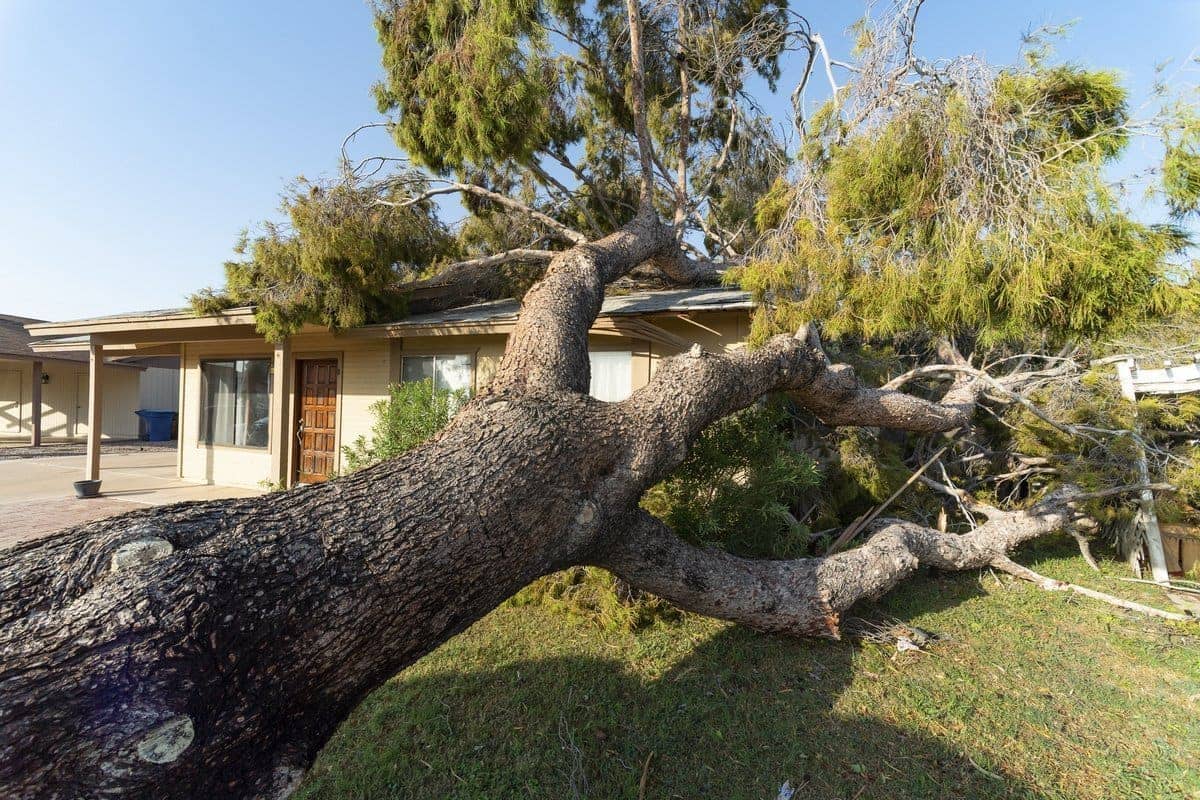
Most of the removals we run in Cullman County weren't surprises. The signs were on the tree for months — sometimes years — before anybody picked up the phone. Knowing what to look for is the difference between a planned takedown on a calm Tuesday and an emergency call at 2 a.m. with a hardwood through the kitchen ceiling. Here are the eight signs we look for first when we walk a property, and what each one usually means for the tree.
First — what we actually mean by a removal
Not every problem tree is a removal. A lot of what looks alarming from the ground is fixable with a structural prune — deadwood out, weight off a heavy leader, clearance over a roof. Removal is the call when the structural problem is in the tree itself: the trunk, the root flare, the major leaders. When the wood you'd need to rely on can't be relied on anymore, that's the line.
If you're not sure which side of that line your tree is on, the section after the list covers the cases where pruning is the better answer. For everything in the list itself, get an honest read from somebody on the ground before you decide.
1. A hard lean toward something that matters
Trees lean for a reason. A gentle, long-standing lean is usually fine — the tree grew that way reaching for light, and the wood and the roots adapted to it. A new lean, or a lean that's gotten visibly worse over a season, is a different conversation. If you can see soil cracking on the windward side, or a slight mound lifting at the base of the trunk, the root plate is failing.
- Watch for:Fresh soil cracks in a half-circle on the side opposite the lean, exposed roots that look lifted, or a tree that's clearly tilted further than it was last year.
- Especially with:Pines after a wet spring, hardwoods on saturated slopes, or any tree on the shoreline side of a Smith Lake lot.
- What it usually means:Removal — and often urgent removal if the lean is toward a house, driveway, or a fence the neighbors share.
2. Dead branches in the upper canopy
Some deadwood in a mature tree is normal — limbs the canopy outgrew, branches the lower interior shaded out. What's not normal is a tree where the top is dying back. If you're looking up at bare branches against the sky in June, with leaves only on the lower third or one side of the crown, the tree is in real trouble. Hardwoods can carry deadwood for years, but a dying top is the canopy telling you the rest is on the way.
Rule of thumb we use on hardwoods: if more than about half of the canopy is dead or missing, the tree isn't coming back. We can sometimes prune around it on a beloved shade tree to buy a season — but the takedown is on the calendar.
3. Cracks, splits, or seams in the trunk
Vertical cracks running up the trunk are the most common structural defect we see on mature hardwoods, especially after an ice event or a hard wind. A hairline crack on bark is one thing — bark moves and re-knits. A crack you can fit a finger into, a crack with darker wood visible inside, or a crack that opens and closes when the wind picks up is a different problem. That's the trunk telling you it's fatiguing.
- Vertical seam splits:Often run from a co-dominant union down the main trunk. Treat these as serious — the tree is preparing to come apart along that line.
- Cracks at a branch union:Where two leaders meet at a tight V with bark folded between them, the union is weak from the day it formed. Cracks there are an invitation for the limb to leave the tree.
- Cracks at the base:The most serious. Anything cracking down where the trunk meets the root flare means the tree is losing its anchor.
4. Fungus or mushrooms at the base or on the trunk
Mushroom-shaped growths — what arborists call conks — are fruiting bodies. The mushroom is the small part. What's inside the tree, working through the heartwood, is the bigger part you can't see. Conks on the lower trunk or at the base of the root flare almost always mean significant internal decay, and the structural wood is already compromised by the time the fungus shows on the outside.
Different fungi are different stories — some attack only dead wood, some are aggressive on live trees — but in residential settings around Cullman, where the target zones are houses and driveways, the safe assumption is that visible conks on a structural trunk mean the tree should come down. Don't wait for a second opinion from gravity.
5. A hollow trunk or visible cavities
A small cavity where a limb used to be isn't automatically a problem — trees compartmentalize wounds, and the outer shell of sound wood is what actually holds the tree up. A hollow you can put your arm into, or a cavity that's eaten through more than about a third of the trunk's diameter, is different. At that point the remaining shell of live wood has to carry the entire load of the canopy through every wind event for the rest of the tree's life.
The honest test is hard to do from the ground, but a few signals point to it: sawdust piles at the base from carpenter ants or borers, dark wet stains running down the bark from a cavity above, woodpeckers that keep coming back to the same spot. Any of those and we'd want to look at the tree closely before the next storm cycle.
6. Root damage, soil heaving, or exposed roots
What's above the ground is only as good as what's below it. Construction within the drip line, a driveway expansion, a trench for a utility line, a year of saturated soil — all of it can damage roots in ways that don't show up in the canopy for one or two growing seasons. By the time you see the symptoms above, the structural anchorage is often already failing.
- Mounding on one side of the trunk:The root plate is starting to lift. This is one of the most reliable pre-failure signs we see on hardwoods.
- Major roots cut by construction:If a contractor trenched within a few feet of the trunk, the tree can stand for years and then come down out of nowhere on a calm afternoon.
- Sparse, undersized leaves:Often the first thing the tree shows when the roots can't supply the canopy. Worth a closer look the next spring.
7. Major storm damage to a leader or the upper third
Cullman gets weather. Spring lines, summer microbursts, ice every few winters — and every one of them takes pieces out of trees. Small to mid-sized broken limbs are pruning work. A blown-out main leader, a top snapped off in the canopy, or a trunk that's split halfway down a major union is removal work. Once the central structure of the tree is gone, what's left rarely recovers in a balanced way, and the new growth that fills in is weak.
If a storm has already come through and you've got damage in the canopy you can't fully see from the ground, the storm-damage post in this blog walks through what to do in the first twenty-four hours and what to expect on the cleanup call. The same playbook applies whether the tree is going to be pruned back into shape or removed.
8. The tree is too close to a structure to manage
Sometimes the tree itself is healthy and the problem is the geometry around it. A pine that grew up two feet from the foundation. An oak that's now leaning hard over the master bedroom because the house went up in 1995 and the tree was already there. A multi-trunk maple growing into the eaves of the garage. These are removals not because the wood failed, but because the room to prune the tree into a sustainable shape doesn't exist anymore.
We'll always tell you straight if a structural prune can buy you another decade. But when the tree's mature form is fundamentally incompatible with what's been built around it, removal is the honest answer — and replanting a smaller species in a better spot is usually part of the conversation.
“The trees we end up removing are almost never the ones nobody saw coming. They're the ones somebody walked past every day for two years and meant to call about.”
— Trenton Clemmons, Clemmons Tree Service
When pruning is the right answer instead
Plenty of trees that look like removal candidates from the ground are actually pruning work. Before you assume the worst, here are the situations where the tree usually stays:
- Deadwood without dieback in the top.Scattered dead limbs in an otherwise full, leafed-out canopy are pruning work — clean out the deadwood, the tree keeps going.
- A heavy lean that's been there for years.An old, stable lean with no fresh soil cracking is something the tree built itself around. We watch it but we don't pull it.
- Limbs encroaching on a roof or driveway.Pure clearance work — crown raise, selective reduction. The tree itself is fine.
- One broken limb after a storm.A clean cut at the collar, weight off the wound, and the tree closes it over. Not a removal.
- Co-dominant leaders without cracks.Caught early, a structural prune to subordinate one of the leaders can save the tree the failure that's otherwise coming in twenty years.
If any of these sound like what you're looking at, the pruning page covers what that work looks like and what changes the price. The honest read is always part of the estimate — we'd rather quote a prune than sell a removal that wasn't necessary.
Species patterns we see around Cullman County
Different species fail in different ways, and the trees common around Cullman have their own patterns. A few that come up most often:
- Loblolly and shortleaf pines:Pine bark beetles, root rot on saturated lots, and the leaner pattern after a wet spring. Most of the storm calls we run on pines start with a lean nobody noticed.
- White and red oaks:Long-lived but prone to dieback when stressed, and especially vulnerable to construction damage in the root zone. Conks at the base of an older oak are always a serious read.
- Sweetgums:Co-dominant unions with included bark are common — the classic split-down-the-middle failure in a wind event. We prune them young when we can.
- Hickories:Heavy wood, slow to show stress, but when they go they go suddenly. We watch hickories that have lost lower limbs to storm damage carefully.
- Eastern red cedar:Hold up well but lean from the wind on exposed sites. Less of a removal driver than a pruning one.
When to make the call
If you've read this far and one or more of the signs above sound like the tree in your yard, it's worth a walk-through. We'd rather come look and tell you it's fine — or that a prune handles it — than have you wait until the wind decides for you. There's no charge for the visit and no obligation either way.
- Don't wait for the storm.The tree that's been showing warning signs for a year is the one that comes down in the next event. The calm-week takedown is always cheaper and safer than the emergency call.
- Photograph what you see.Phone photos of the lean, the crack, the conk, the dead limbs — they help us plan the gear before we leave the shop.
- Keep people and pets clear.If a tree is visibly leaning toward a structure or has a cracked trunk, stay out of the fall zone until it's been assessed.
- Call when something changes.A new lean, a fresh crack, soil cracking after a storm — those are the calls we'd rather take same-day.
For a free estimate on a hazard tree anywhere in Cullman or the surrounding county — or just an honest second opinion on whether the tree needs to come down at all — call (256) 595-0939 or send a note to trentonclemmons3@gmail.com. Most calls are answered live, and we'll come walk the property at no charge.
Trenton Clemmons, Owner