

Almost every Bradford pear tree removal we do around Cullman starts with one of two phone calls. The first comes the morning after a spring storm: half the tree is lying across the driveway, the other half is still standing, and the trunk is torn open down the middle like a pulled wishbone. The second comes from the house next door, from somebody who watched that happen and wants to know whether theirs is next.
Usually it is. That is not bad luck or a bad tree — it is how this tree is built. What follows is what we tell people standing in the yard: why Bradford pears split, how to tell when yours is getting close, what pruning can and cannot do for one, and why taking it out is a two-part job. The tree is the first part. The stump is the second, because a Callery pear stump left in the ground does not stay quiet.
A Bradford pear is a Callery pear, and that is the problem
‘Bradford’ is the best-known variety of Callery pear, a tree native to Asia that was brought to the United States in the early 1900s to help breed disease resistance into fruiting pears. It turned into a landscaping favorite for reasons that made perfect sense at the time. It grows fast, it tolerates almost any soil, it blooms early and heavily, and it holds a tidy teardrop shape without anybody touching it. For a builder finishing a subdivision, that was the ideal front-yard tree: cheap, quick, and full-looking by the time the house sold.
A couple of decades on, plenty of those trees are still standing in front yards from Cullman to Hanceville to Vinemont, and a lot of them have reached the age where the trouble starts. The Alabama Cooperative Extension System now goes as far as recommending that homeowners consider removing planted Callery pears from their landscapes altogether — for reasons that have as much to do with the rest of the state as with your roof.
How to tell if the tree in your yard is one
If you are not sure what you have, a Bradford pear is one of the easier trees to identify in any season.
- In early spring.Clouds of small white flowers, five petals each, open sometime between late February and April — before or right as the leaves come out. Get close and you will see dark maroon tips on the stamens, and you will notice the smell, which almost nobody describes kindly.
- In fall.Glossy, rounded leaves with finely scalloped edges that hang on late and turn red, maroon, orange, or yellow. Small speckled fruit, under half an inch across, dangle on long stems. Nothing you would mistake for a pear you could eat.
- By its shape.A tight, upright teardrop, with a cluster of big limbs leaving the trunk from nearly the same spot instead of spaced up and down it. That cluster is the part to remember.
- In the wild.The thorny, white-flowering thickets along fence rows, pasture edges, and roadsides across north Alabama are the same species gone feral — Callery pear seedlings that reverted to the wild type.

Why Bradford pears split
A well-built shade tree has one main trunk with branches attached along its sides, each joined to the trunk by interlocking wood. A Bradford pear grows the opposite way. Several upright limbs of nearly equal size leave the trunk from almost the same point, at tight, narrow angles, and they spend the next twenty years growing into each other.
As those limbs thicken, bark gets pinched into the V between them. Arborists call it included bark, and it is most of the story. Bark is not wood and does not bond, so the joint holding half the tree to the other half is really a thin shell of wood on either side of a seam that was never connected. Every year the crown gets bigger and heavier. The joint does not get stronger to match.
Then add weather. A Bradford pear grows a dense crown that catches wind like a sail and holds rain and ice. Around here the failure almost always comes during a line of spring thunderstorms, with the canopy fully leafed out and soaked, or during the occasional north Alabama ice storm. The union opens, one leader peels away, and it takes a strip of trunk with it.
Even the nursery trade gave up on the original. The Extension Service notes that ‘Bradford’ was found to be structurally weak because of its branching pattern, and other Callery pear varieties replaced it on nursery lots. Most extension sources put a Bradford pear’s useful life somewhere between about ten and twenty years before the splitting starts — which puts a lot of trees planted in the 2000s squarely in the window right now.
“A Bradford pear doesn’t fall over. It comes apart. Half the tree is still standing in the yard, and the other half is on your car.”
— Trenton Clemmons, Clemmons Tree Service
Signs your Bradford pear is getting close
You do not need a climbing harness to check yours. Stand back far enough to see the whole tree, then walk up to the trunk and look into the spot where the big limbs leave it.
- A crack or dark seam at the main union.A vertical line running down from the V, staining or weeping below it, or a gap you could slide a credit card into. That is the joint already moving.
- Bark folded into a tight V.A healthy branch union shows a raised ridge of bark pushed up between the limbs. A pinched, inward-folded seam with no ridge is included bark.
- A limb already gone.Once one leader tears out, the wound is large, the remaining leaders have lost the neighbor that was bracing them, and decay has an open door. A Bradford pear that has lost a major limb is rarely a tree worth keeping.
- Decay or mushrooms.Soft wood at an old tear, a cavity at the union, or fungus growing at the base or on the trunk.
- A crown that has outgrown its spot.Limbs over the roof, the driveway, the parked cars, the service drop, or the neighbor’s fence. A split is a lot less interesting when there is nothing under it.
Any one of those is worth having somebody look at. Two or more on a tree that is fifteen or twenty years old, and you are not really deciding whether it comes out — just when. They are the same warning signs we read on any hazard tree, applied to a species that tends to show several of them at once.

Can pruning save a Bradford pear?
Sometimes it can buy time. It cannot change how the tree is built, and we would rather say that up front than sell you a trim that will not hold.
- On a young tree, structure is everything.In its first several years, a good pruner can pick one main leader, take out the competing ones, and space the remaining limbs along the trunk instead of in a cluster. It costs you the perfect teardrop. It gets you a tree far less likely to split.
- On a mature tree, pruning is maintenance, not a cure.Included bark cannot be undone. What pruning can do is take weight off the ends of the longest, heaviest leaders and open the crown enough to let wind through. That lowers the load on a weak union for a few years, and then it has to be done again.
- Topping makes it worse.Cutting a Bradford pear back to stubs triggers a mass of fast, weakly attached sprouts that break more easily than what was there before. We do not top trees, this one included.
If the tree is young, stands well clear of anything it could hit, and you like it, structural pruning is a reasonable plan. If it is mature, already showing the signs above, and hanging over the house, pruning only postpones the removal.
Keep it or take it out
Once you know what you are looking at, the decision usually comes down to a handful of questions.
- Take it outif it is within falling distance of the house, the driveway, a play area, or a power drop; if it has already split or lost a limb; if it is fifteen-plus years old with a tight, multi-stem union; or if you were planning to replace it anyway.
- Keep it, for now,if it is young, has room to fall without hitting anything, shows a sound union, and you are willing to prune it on a schedule.
There is a second reason the Extension Service recommends removing them, and it has nothing to do with your house. A lone ‘Bradford’ rarely set fruit, because every one was a genetic copy of the same tree. Once the newer Callery varieties went into the ground beside them, the trees began cross-pollinating, setting seed, and handing it to the birds. The result is the thorny Callery pear thickets now crowding pastures, fence rows, and rights-of-way. Ohio went as far as banning its sale starting in 2023, and other states have since moved in the same direction.
How a Bradford pear comes down
Bradford pears top out somewhere around thirty to sixty feet, so they are rarely the biggest tree on the lot. They are almost never planted anywhere convenient, though. They sit between the house and the driveway, beside the mailbox, under the service drop, or a few feet off the neighbor’s fence, which means very few of them can simply be dropped in one piece.
- An intact tree with open ground around itcan sometimes be felled whole or in a few big pieces. That is the fastest, simplest version of the job, and the estimate will say so.
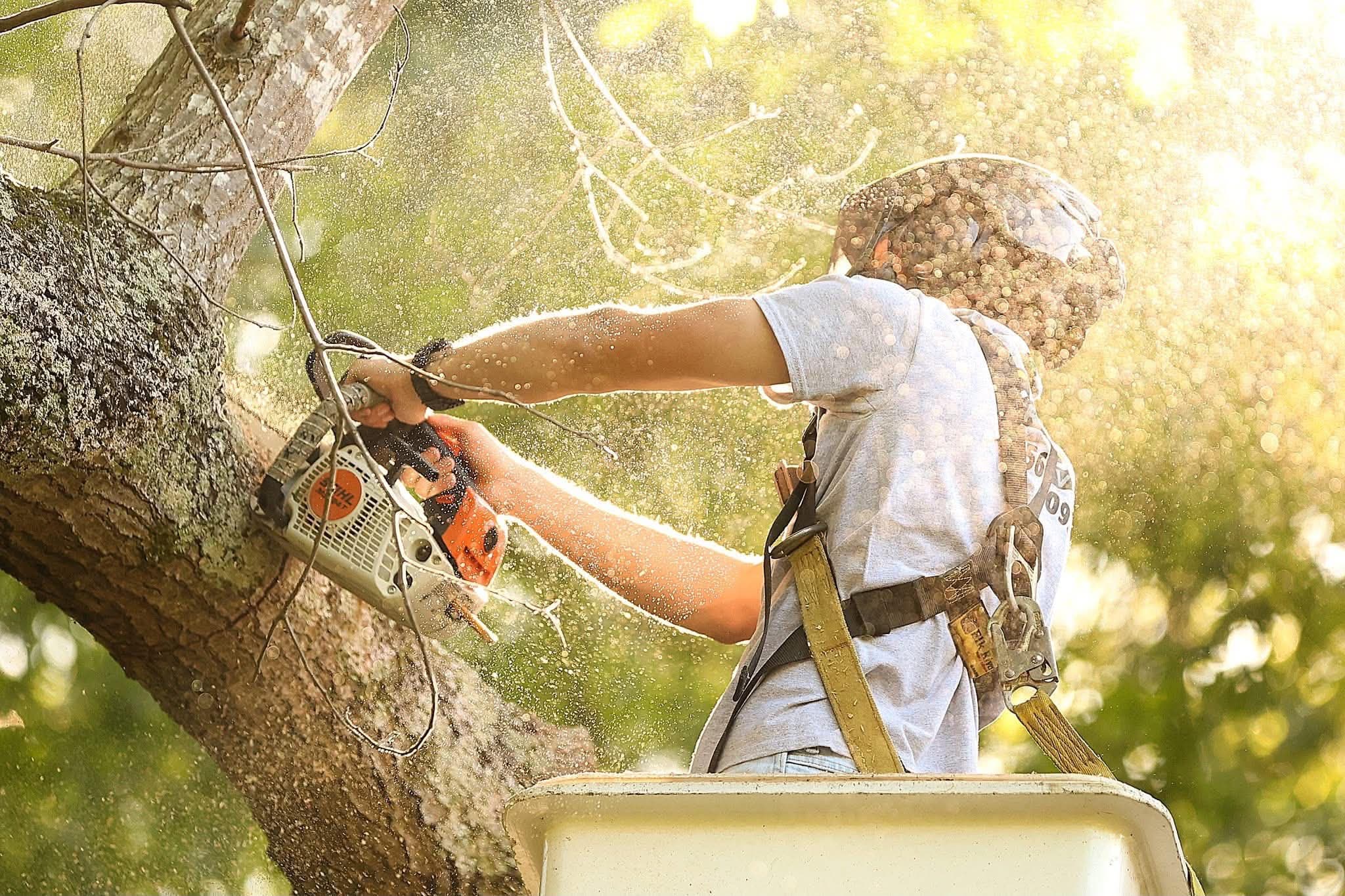
- A tree in a tight spotcomes down from the top: limbs cut in sections from the bucket or by a climber and lowered on rigging, then the trunk taken down in rounds. Nothing lands anywhere we did not plan for it to land.
- A tree that has already splitis a different animal. The torn halves are loaded against each other, and the wood can shift or release when the first cut goes in. Those get cut from positions that keep everybody out of the line of release, which is exactly why this is not a chainsaw-and-a-ladder Saturday project.
If a split pear is on the roof or across the driveway right now, skip the reading and call — that is what our emergency tree service is for. Otherwise, the price of a planned removal comes down to the same handful of factors as any other tree: size, what is underneath it, access, cleanup, and the stump. Every one of those is covered in our breakdown of what tree removal costs in Cullman, and all of it gets settled on a free on-site estimate, with a fixed price before any work starts.
Don’t skip the stump — a Callery pear sprouts back
Here is the part that catches people off guard. Cut a Bradford pear down, leave the stump, and the tree is not finished with you. Callery pear sprouts from the stump and from its lateral roots, sometimes several feet out into the lawn, and it keeps sprouting for as long as those roots have energy to spend.
Those sprouts are not a new Bradford, either. Many Bradford pears were grafted onto Callery pear rootstock, so what comes up from the roots is wild-type Callery pear — the same tree that builds the roadside thickets, and often a thorny one.
That is why the Extension Service’s advice for a large landscape Callery pear is specific: remove the tree, then grind the stump, and get the lateral roots out too. Stump grinding takes the stump and the root flare below grade and follows the main roots out a few feet in each direction, which removes most of what the tree would sprout from.
- Standard depth, 4–6 inches below grade,for grass or sod over the spot.
- Deeper, roughly 8–12 inches,if a replacement tree is going in nearby. Set the new tree off to one side of the old stump rather than right on top of it.
- Quoted on the same visit.Removal and grinding are separate line items, and we price both while we are standing at the tree so you see the whole job up front. On a Callery pear, leaving the stump is how a lawn turns into a thicket.
A few sprouts can still show up the first season from roots the grinder did not reach. Pull or clip them while they are small, and regular mowing will keep any in the lawn in check. If grinding is not an option — a stump sitting on a septic field, for example, where we will not run a grinder — the Extension Service recommends treating the fresh-cut stump with herbicide right away. We do not apply chemicals; that is a job for you, following the label, or for a licensed applicator. We do call 811 to have utilities marked before any grinder turns on. What the grinder leaves behind, and how to bring the yard back over it, is covered in our stump grinding guide.
What to plant instead
We do not plant trees — we are the crew that clears the way for whoever does. But we get asked this on nearly every Bradford pear job, and the Extension Service has a good answer. For white spring flowers, look at serviceberry, hawthorn, native crabapple, or native plum. For fall color, Florida maple, chalk maple, and blackgum are all native here, and none of them carry the Callery pear’s habit of splitting down the middle.
Whatever goes in, give it room. Look up the mature spread, not the size of the pot, and plant it far enough from the house and the driveway that nobody is making this same phone call twenty years from now.
The best time for Bradford pear removal in Cullman
If the tree has already split, the best time is now. If it is standing and sound, late fall through winter is the window we like.
- The structure is easy to read.With the leaves down, the union, the cracks, and any old tears are right there to see — for you and for us.
- There is less to haul.A bare crown is lighter to rig and faster to chip and clean up than one in full leaf.
- It is done before storm season.These trees fail in spring and early-summer storms with a full canopy. Take one down in January and it is not part of that conversation.
- The one trade-off is soft ground.North Alabama winters can be wet. Mats and plywood keep the equipment off the turf, and if the yard is saturated we wait for it to dry rather than rut the lawn.
Bradford pear questions we get around Cullman
Should I cut down my Bradford pear tree?
If it is mature and within reach of your house, driveway, or a power drop — or it has already split or lost a limb — most of the time, yes. Bradford pears grow several leaders crowded into one weak union, and they tend to start failing somewhere between ten and twenty years old. The Alabama Cooperative Extension System also recommends replacing planted Callery pears because the species has become invasive. A young tree with open ground around it can be kept with structural pruning if you like it, but on an older tree, pruning only buys time.Why do Bradford pear trees split in half?
Because of how they branch. Several upright limbs leave the trunk from nearly the same point at narrow angles, and as they grow, bark gets trapped in the joints between them. That included bark does not bond, so the union holding the tree together is weaker than it looks while the dense crown keeps getting heavier. Wind on a leafed-out canopy, rain, or ice eventually overloads the joint, and one side tears away — usually taking part of the trunk with it.Will a Bradford pear grow back after it is cut down?
It will try. Callery pear sprouts from the stump and from its lateral roots, and those sprouts come up as wild-type Callery pear, which can be thorny. The Alabama Extension Service recommends removal followed by stump grinding for large landscape trees, with the lateral roots taken out as well. A few sprouts may still appear the first season; pull or clip them while they are small.How long do Bradford pear trees live?
Not long, as trees go. Extension sources generally put a Bradford pear’s useful life somewhere between about ten and twenty years before splitting and decline set in. Some last longer, especially if they were structurally pruned young, but a twenty-year-old Bradford pear with a tight, multi-stem union should be treated as a tree on borrowed time.How much does Bradford pear tree removal cost?
It depends on the job, not the species — the size of the tree, what is underneath it, how easy it is to reach, the cleanup, and whether you want the stump ground. A pear in an open backyard is a very different job from one hanging over a roof and a power drop. For a removal we need to see the tree, so we price it on a free on-site estimate and give you a fixed price for the removal and the stump grinding before any work starts.
Bradford pear tree removal in Cullman, in short
A Bradford pear is a Callery pear, built from day one with several leaders crowded into one weak joint. It grows fast, gets heavy, and somewhere between ten and twenty years old it starts coming apart — usually in a storm, and usually over something that matters. Pruning a young one can help; pruning a mature one only buys time. When it comes out, grind the stump and the main roots too, or the tree comes back as a thicket. And if it is going to come down, a calm winter week beats a stormy spring morning.
For a free, no-obligation look at a Bradford pear anywhere in Cullman and the surrounding areas, call (256) 595-0939 or email trentonclemmons3@gmail.com. We will walk the tree with you, tell you straight whether it can be kept, and if it is coming out, quote the removal and the stump grinding together on the same visit. Fully insured, fixed price up front, and the yard cleaned up before we leave.
Trenton Clemmons, Owner